Skip to content
Custom plush toys must meet the rules of the market where they will be sold—not simply the rules of the country where they are manufactured. For the United States, a children’s plush toy commonly needs to comply with applicable CPSC requirements, including the mandatory toy standard based on ASTM F963, and may require third-party testing and a Children’s Product Certificate. For the European Union, buyers must address the EU toy-safety framework, applicable EN 71 standards, conformity assessment, technical documentation, and CE marking.
The exact test plan depends on the toy’s intended age group, materials, accessories, electronics, packaging, and sales market. Compliance should therefore be defined before sampling and confirmed before mass production.
Short answer: Tell your manufacturer the destination country, intended age grade, materials, accessories, and sales channel at the start of the project. These details determine which tests, labels, documents, and design controls may apply.
Table of Contents
ToggleWhich safety standards apply to custom plush toys?
There is no single worldwide certificate that automatically approves a plush toy for every country. A test report prepared for one market may not satisfy another market’s requirements.
| Sales market | Common framework for children’s plush toys | Typical buyer deliverables |
|---|---|---|
| United States | CPSC rules, the mandatory toy standard incorporated through 16 CFR Part 1250, applicable CPSIA requirements, and ASTM F963 | Test reports from a CPSC-accepted laboratory when required, Children’s Product Certificate, tracking information, and compliant labeling |
| European Union | EU toy-safety legislation and applicable harmonized standards such as relevant parts of EN 71 | Technical documentation, risk assessment, Declaration of Conformity, CE marking, traceability information, and applicable test reports |
| United Kingdom | UK toy-safety rules and applicable designated standards | Market-specific conformity documentation and markings |
| Canada, Australia, and other markets | National toy-safety laws and standards | Requirements must be confirmed for each destination market |
This table is a planning summary, not a complete legal test list. A qualified compliance specialist or accredited laboratory should determine the final requirements for each design.
What does ASTM F963 mean for plush toys sold in the United States?
ASTM F963 is the central toy-safety standard used in the United States. The U.S. Consumer Product Safety Commission states that the version incorporated by 16 CFR Part 1250 is mandatory for applicable toys. The currently accepted ASTM F963-23 requirements became effective on April 20, 2024.
Depending on the plush design and intended age group, evaluation may include issues such as:
- Small parts and detachable components
- Seam strength and access to stuffing
- Sharp points or sharp edges
- Accessible cords, loops, and attachments
- Heavy metals in surface coatings or substrates
- Phthalates in accessible plasticized components
- Cleanliness and suitability of filling materials
- Flammability-related hazards
- Battery compartments, sound modules, lights, or other electronic functions
Not every section applies to every plush toy. A simple embroidered plush pillow and a battery-operated talking plush may require very different test plans.
According to the U.S. Consumer Product Safety Commission’s toy-safety guidance, toys intended primarily for children aged 12 or younger generally require third-party testing by a CPSC-accepted laboratory for applicable children’s product safety rules.
What is CPSIA compliance for a custom plush toy?
CPSIA is not just a logo or a single laboratory test. It is a U.S. legal framework that includes requirements affecting children’s products, such as limits for lead and certain phthalates, testing and certification obligations, and tracking-label provisions.
For an imported children’s toy, the U.S. importer is generally responsible for issuing the Children’s Product Certificate based on passing third-party test results. The laboratory provides the test report; it does not issue the CPC on the importer’s behalf.
The CPSC explains that a CPC must identify the product, applicable rules, certifying party, records contact, manufacturing details, testing details, and the laboratory used. See the official Children’s Product Certificate guidance.
Beginning July 8, 2026, importers of most regulated consumer products are also subject to the CPSC’s electronic filing requirements for certificate data. U.S. buyers should confirm the current filing workflow with their customs and compliance teams before shipment.
Does a plush toy need a tracking label?
Children’s products sold in the United States generally need permanent, distinguishing tracking information on the product and its packaging to the extent practicable.
The information should make it possible to identify:
- The manufacturer, importer, or private labeler
- The location and date of production
- A batch, run, or other production identifier
- Other information needed to trace the product’s source
For a plush toy, the tracking information is often placed on a sewn-in label and repeated on the retail packaging when applicable. The final format should be approved before mass production because changing sewn labels after production can be expensive and slow.
Read the CPSC’s official tracking-label guidance for the complete requirements.
What do EN 71 and CE marking mean for plush toys sold in the EU?
For the European Union, EN 71 is a family of standards used to evaluate different toy hazards. The parts that apply depend on the product. Common considerations for plush toys may include mechanical and physical properties, flammability, and migration of certain elements.
CE marking is not a factory quality badge. It is the manufacturer’s declaration that the product meets applicable EU requirements after the required conformity-assessment process has been completed. Supporting technical documentation and a risk assessment must be prepared and retained by the responsible economic operator.
The EU’s new Toy Safety Regulation entered into force on January 1, 2026, with its main requirements scheduled to apply from August 1, 2030. It introduces stronger chemical restrictions and a digital product passport. Brands planning multi-year plush programs should prepare their product-data and traceability systems early. See the European Commission’s official announcement.
Are factory audits the same as product safety tests?
No. Factory-management and social-compliance systems can help buyers assess how a supplier operates, but they do not replace design-specific product testing.
For example, ISO 9001 relates to quality-management systems, while BSCI, Sedex, ICTI, and similar programs focus on factory or social-compliance practices. A factory may hold these credentials and still need a new finished-product test for a specific plush design, material combination, or production batch.
Buyers should verify both:
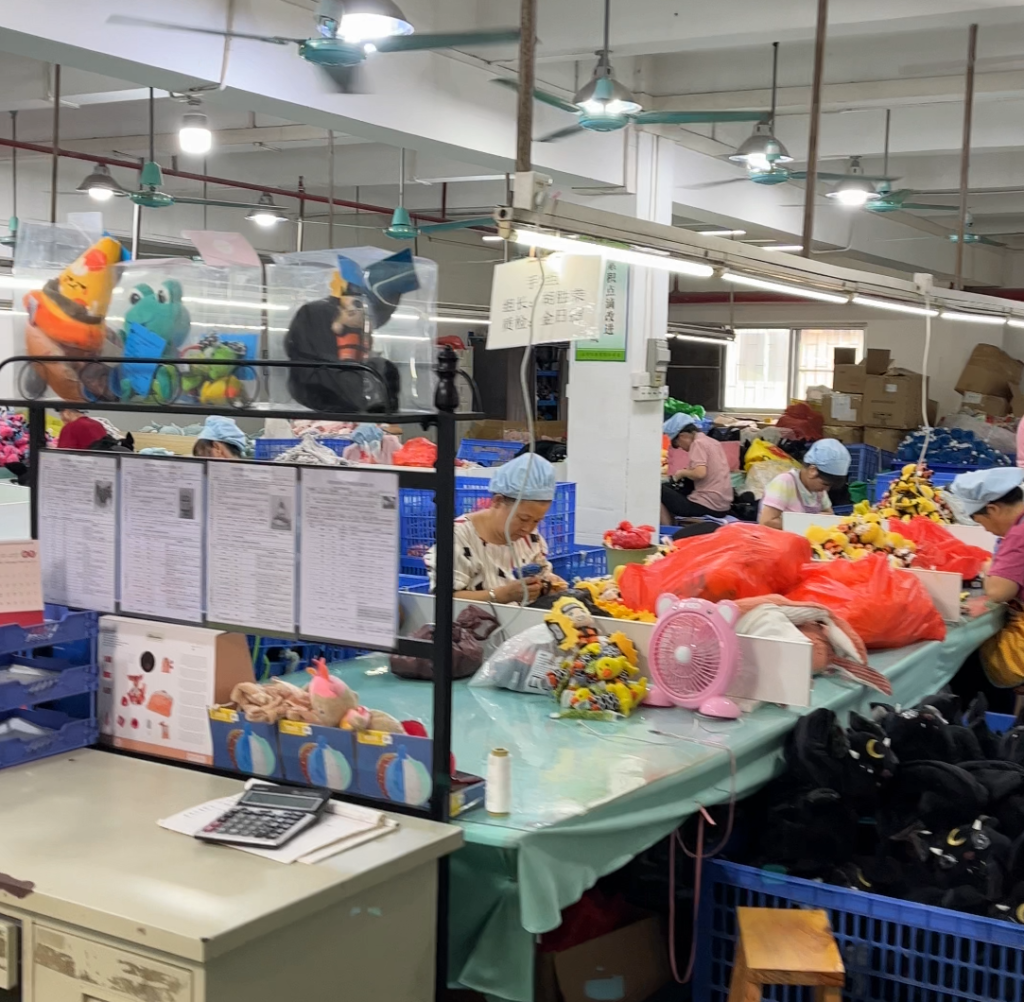
- Factory capability: quality controls, traceability, needle control, incoming-material checks, production inspections, and audit status.
- Product compliance: the actual test plan, laboratory reports, labels, certificates, and documentation required for the destination market.
When should safety requirements be confirmed?
Safety requirements should be confirmed before the first production sample, not after mass production is finished.
An efficient sequence is:
- Define the destination market and sales channel.
- Confirm the intended age grade.
- Identify all fabrics, fillings, trims, plastic parts, coatings, and electronics.
- Review the design for foreseeable hazards.
- Ask a qualified laboratory to define the applicable test plan.
- Build the requirements into the sample and sewn-in label.
- Approve the final pre-production sample.
- Produce the order using controlled materials and approved specifications.
- Complete required testing, documentation, and certification before shipment.
Testing only at the end creates avoidable risk. If a button, zipper pull, plastic eye, sound module, or label fails, the entire batch may require rework.
Which plush toy design choices can change the test plan?
Several design decisions can materially change compliance requirements and testing cost:
Intended age
A plush toy intended for a baby or child under three needs special attention to small parts, cords, accessible stuffing, and other age-related hazards. Age grading must reflect the product’s design and foreseeable use; it should not be selected only for marketing convenience.
Eyes, noses, buttons, and accessories
Embroidered features can reduce detachable-component risks compared with some hard plastic parts, but every design must still be evaluated. Bells, magnets, key rings, suction cups, and decorative charms may introduce additional requirements.
Fabric, printing, and coatings
Fabric composition, dyes, printed areas, artificial leather, PVC components, and surface coatings can affect chemical testing. Material declarations from suppliers help, but finished-product testing may still be required.
Electronics
Light, sound, recording, Bluetooth, heating, or battery functions can add electrical, battery, EMC, radio, or additional labeling requirements depending on the market.
Packaging and labeling
Polybag warnings, age warnings, importer information, recycling marks, tracking information, care labels, and language requirements should be defined before packaging production.
What information should a buyer send to the manufacturer?
To receive a more accurate compliance plan and quotation, send the following information with your plush design:
- Front, side, and back artwork or a three-view drawing
- Finished size and tolerance
- Intended age group
- Destination countries
- Sales channel, such as retail, Amazon, promotional distribution, or crowdfunding
- Preferred fabric and filling
- Details of embroidery, printing, plastic parts, magnets, electronics, or accessories
- Sewn-in label and packaging requirements
- Required test standards or retailer protocols
- Estimated order quantity and launch date
If some details are not available, clearly mark them as undecided. Early disclosure helps the factory and laboratory identify risks before they become expensive production changes.
How can Iplushie support a compliance-ready custom plush project?
Iplushie can review your design for manufacturability, develop a physical sample, confirm materials and construction details, and coordinate production controls based on the approved specification. The final legal responsibilities, market requirements, test plan, certification, and import documentation should be confirmed by the buyer, responsible economic operator, and an accredited laboratory.
To understand how a design becomes a production-ready sample, read How Are Plush Toys Made?. You can also review the custom plush toy cost and MOQ guide before preparing your project budget.
For a project-specific review, contact Iplushie with your artwork, target market, age grade, size, quantity, and launch date.
Frequently asked questions
Do all custom plush toys need ASTM F963 testing?
ASTM F963 applies to toys for the U.S. market, but the exact sections and third-party testing requirements depend on the product and intended age group. A CPSC-accepted laboratory should define the applicable test plan.
Is an EN 71 report enough to sell a plush toy in the United States?
No. EN 71 is associated with the European market and does not replace applicable U.S. CPSC, CPSIA, and ASTM F963 requirements.
Is a CPSIA test report the same as a Children’s Product Certificate?
No. A laboratory issues test results. The responsible domestic manufacturer or importer issues the CPC based on applicable passing test results.
Can one test report cover every plush toy color and size?
Not automatically. Differences in materials, coatings, accessories, construction, or components may affect whether products can be grouped. Confirm product-family rules with the laboratory before testing.
Should testing happen before or after mass production?
Safety planning should begin before sampling. The final testing point depends on the compliance program, but buyers should avoid waiting until the full batch is complete to discover a design problem.
Does a factory audit replace finished-product testing?
No. Factory audits evaluate systems or operating practices. Product tests evaluate a specific toy against applicable safety requirements.